Shopping Cart
Total:

$0.00

Items:

0

Your cart is empty
Keep Shopping

How Can WHO Recommendations Improve Infertility Outcomes?

Infertility, affecting an estimated 48 million couples globally, is a critical public health issue. The World Health Organization (WHO) has released updated guidelines to standardize and optimize its prevention, diagnosis, and treatment. These guidelines aim to improve access to quality care and reduce infertility’s burden across diverse health settings. Beyond emotional and social distress, infertility has significant medical and economic consequences, necessitating a comprehensive, evidence-based response.

This blog explores key WHO recommendations for infertility management, highlighting prevention strategies, effective diagnostic tools, and treatment options, including assisted reproductive technologies (ART). Incorporating these guidelines into clinical practice can enhance patient outcomes while promoting ethical and equitable reproductive healthcare. This post is optimized for the keyword: “WHO guideline for the prevention, diagnosis, and treatment of infertility.

Key Highlights of the WHO Infertility Guidelines

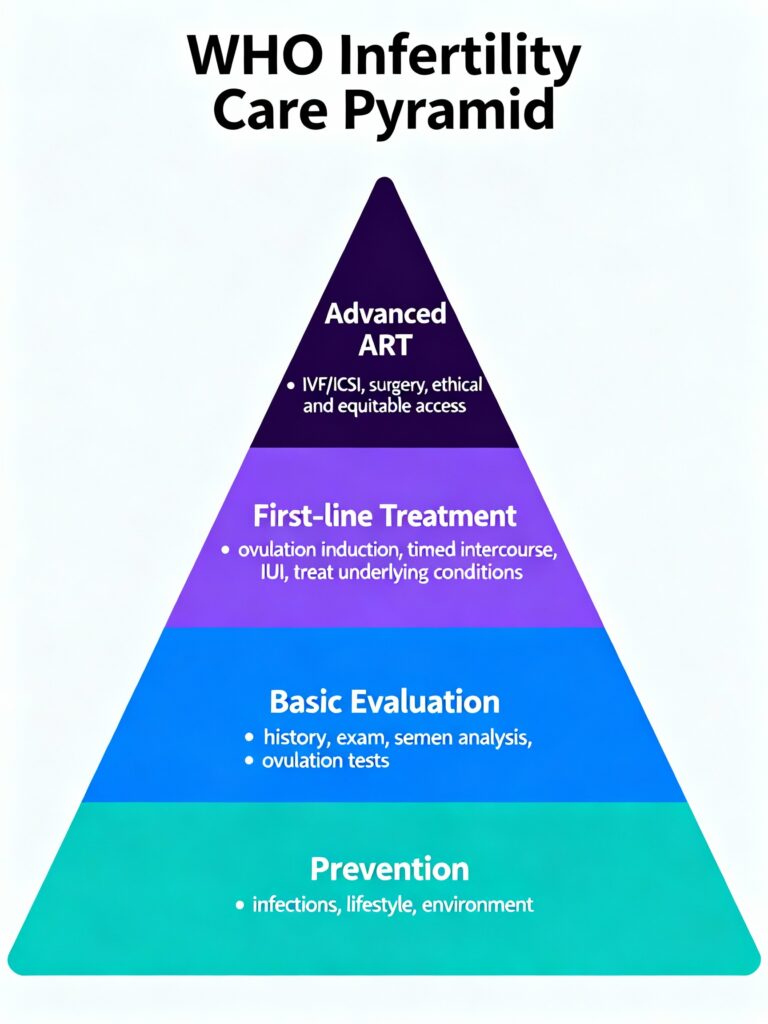
The WHO guideline provides a structured approach spanning prevention, diagnosis, and management, summarized as follows:

“Infertility is often a silent problem that carries heavy psychosocial stress; comprehensive guidelines are essential to ensure quality, respectful, and equitable care.”

Prevention

  • Promote healthy lifestyle factors affecting fertility such as smoking cessation, alcohol moderation, and managing weight.

  • Provide comprehensive education on sexual and reproductive health to prevent infections and preserve reproductive potential.

  • Address environmental and occupational exposures that may impair fertility.

Diagnosis

  • Employ a stepwise diagnostic workup beginning with medical history, physical examination, and basic semen analysis and ovulation assessment.

  • Use ultrasound and hormonal tests as adjuncts.

  • For complex cases, consider advanced diagnostics like hysterosalpingography and laparoscopy.

  • Emphasize minimizing invasive procedures.

Treatment

  • Start with less invasive, affordable treatments such as ovulation induction and intrauterine insemination (IUI).
  • Escalate to in vitro fertilization (IVF) or intracytoplasmic sperm injection (ICSI) as appropriate and accessible.

  • Ensure psychological counseling and support services.

  • In low-resource settings, prioritize simplified IVF protocols to expand access.

Equity and Ethics:

  • Guidelines stress equitable access irrespective of socioeconomic status, geography, or gender.

  • Encourage non-discriminatory practices and informed patient choice.

  • Emphasize safeguarding patient confidentiality and autonomy.

“Prevention and early diagnosis save not only resources but also patients from complex interventions that may cause physical and emotional burden.”

Equity and Ethics

  • Guidelines stress equitable access irrespective of socioeconomic status, geography, or gender.

  • Encourage non-discriminatory practices and informed patient choice.

  • Emphasize safeguarding patient confidentiality and autonomy.

Conclusion

WHO’s infertility guidelines offer a crucial framework for global reproductive healthcare. Emphasizing prevention, efficient diagnosis, tiered treatment, and equitable access, these recommendations can lessen the physical, emotional, and financial strains of infertility. Clinicians and policymakers should adopt these guidelines to improve patient care, advance reproductive rights, and enhance fertility outcomes globally.

Show Comments (0) Hide Comments (0)
0 0 votes
Article Rating
Subscribe
Notify of
guest
0 Comments
Oldest
Newest Most Voted
Inline Feedbacks
View all comments
0
Would love your thoughts, please comment.x
()
x