






Shopping Cart
Total:

$0.00

Items:

0

Your cart is empty
Keep Shopping

Key Health Risks After Pregnancy Complications

Pregnancy complications such as pre-eclampsia, gestational diabetes, preterm birth, and placental disorders are not just short-term obstetric events; they predict a woman’s long-term cardiometabolic, renal, and mental health trajectory and demand structured postpartum prevention.

When Pregnancy Is a Stress Test: Lifelong Health Risks After Obstetric Complications

The review positions pregnancy as a “physiological stress test” that unmasks underlying vulnerabilities to chronic disease. It synthesizes evidence linking common obstetric complications—pre-eclampsia, gestational hypertension, gestational diabetes mellitus (GDM), placental abruption, preterm birth, stillbirth, and miscarriage—with increased long-term maternal risks of cardiovascular disease, type 2 diabetes, metabolic syndrome, renal dysfunction, and higher all-cause mortality for up to 40 years after delivery.​

Women with prior GDM have up to a tenfold higher risk of type 2 diabetes, while those with pre-eclampsia have a three- to fourfold higher risk of future cardiometabolic disease. The review also highlights emerging mechanisms involving the gut microbiota, which interacts with reproductive and metabolic hormones and may influence pregnancy outcomes and offspring risks for allergies, neurodevelopmental disorders, and later disease.​

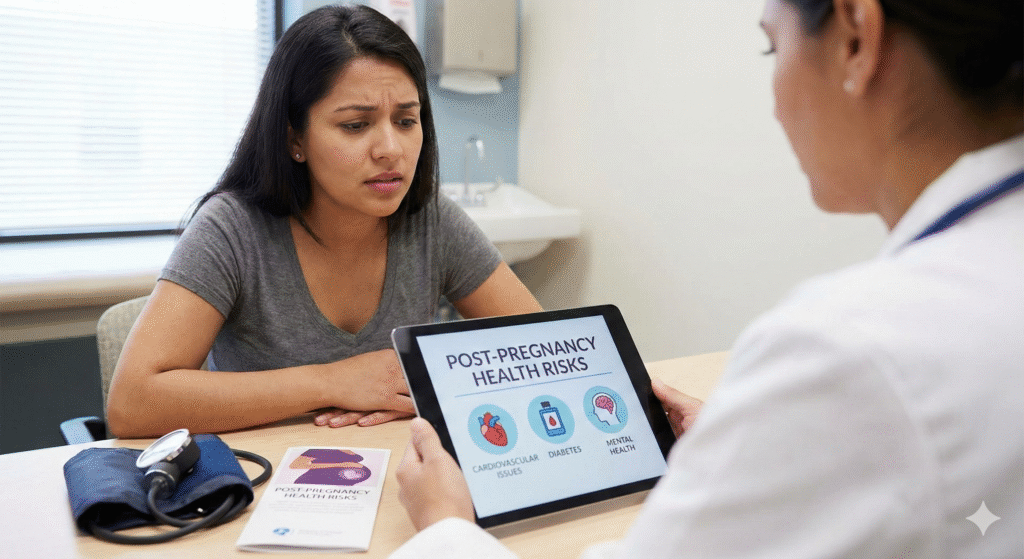
Preventive strategies are anchored in comprehensive postpartum care: pain and wound management, mental health screening, glycemic and blood pressure monitoring, breastfeeding promotion, healthy diet and graded exercise, bladder–bowel care, appropriate contraception (favoring progestin-only methods during breastfeeding), and robust health education on newborn care and maternal warning signs. The authors call for a paradigm shift in primary care that explicitly incorporates obstetric history into lifetime cardiovascular and metabolic risk assessment and follow-up

Obstetric ComplicationLong-Term Maternal RiskKey Postpartum Strategy
Gestational Diabetes Mellitus (GDM)Up to 10× higher risk of type 2 diabetes, metabolic syndrome. ​75 g OGTT/fasting glucose, lifelong metabolic follow-up, diet–exercise counseling. ​
Pre-eclampsia / Gestational Hypertension3–4× increased cardiometabolic disease, higher mortality. ​BP and renal monitoring, cardiovascular risk assessment, counseling for future pregnancies. ​
Preterm Birth / SGA InfantElevated long-term CVD and mortality risk. ​Early primary care linkage, lifestyle modification, periodic CVD screening. ​
Recurrent Miscarriage / StillbirthAssociated with adverse vascular and inflammatory profiles. ​Evaluation for thrombophilia/autoimmune disease, mental health support, tailored preconception care. ​
Cesarean in Pre-eclampsiaHigher perioperative morbidity and multi-organ stress. ​Careful anesthetic management, thromboprophylaxis, organ-protective perioperative strategies. 

Key Findings

  • Obstetric complications (preterm delivery, SGA infants, PE, GDM, gestational hypertension) are independent predictors of increased long-term maternal cardiovascular morbidity and mortality.​

  • GDM increases the risk of future type 2 diabetes up to tenfold; PE significantly elevates future cardiometabolic disease risk three- to fourfold.​

  • PE and GDM, though often resolving postpartum, reflect maladaptive physiological responses with persistent vascular, metabolic, and inflammatory consequences.​

  • Gut microbiota dysbiosis is linked to pregnancy complications (PE, GDM, preterm birth, recurrent miscarriage) and may raise offspring risk of allergies and neurodevelopmental disorders, with high-fiber diets and probiotics suggested as protective measures.​

  • Breastfeeding reduces maternal risk of type 2 diabetes, breast cancer, and ovarian cancer and lowers infant risk of eczema, pediatric cancers, and gastrointestinal infections.

  • Targeted postpartum interventions (mental health screening, contraception counseling, glucose tolerance testing, lifestyle guidance) are underutilized but critical for long-term prevention.

Key Findings

  • Treat adverse pregnancy outcomes as early warning markers: integrate obstetric history into cardiovascular and metabolic risk stratification for all women.​

  • For women with prior GDM, perform a 75 g two-hour oral glucose tolerance test or fasting plasma glucose postpartum and ensure lifelong glycemic monitoring.​

  • In women with pre-eclampsia, emphasize blood pressure surveillance, renal function checks, and counseling on future pregnancy risk and ASCVD prevention.​

  • Routinely screen for postpartum depression and anxiety using validated tools; refer and adjust psychotropic medications considering lactation status.​

  • Strongly promote and support breastfeeding (WHO: every 3–4 hours for at least 4–6 months) to harness its maternal–infant protective effects.​

  • Address postpartum weight retention with individualized diet and exercise plans (starting with non-impact activities, avoiding heavy exertion in first 2–3 weeks).​

  • Discuss contraception during pregnancy and early postpartum, favoring nonhormonal or progestin-only methods in breastfeeding women to avoid lactation suppression.​

Show Comments (0) Hide Comments (0)
0 0 votes
Article Rating
Subscribe
Notify of
guest
0 Comments
Oldest
Newest Most Voted
Inline Feedbacks
View all comments
0
Would love your thoughts, please comment.x
()
x