Shopping Cart
Total:

$0.00

Items:

0

Your cart is empty
Keep Shopping

Late Delivery for Accreta: Is It Possible ?

Placenta accreta spectrum (PAS) is a serious condition that requires careful management. It occurs when the placenta attaches too deeply into the uterine wall. This can lead to significant complications during delivery.
Understanding the optimal timing for delivery is crucial for managing PAS. Delivery timing can impact both maternal and fetal health outcomes. It is typically recommended between 34 and 36 weeks of gestation.
Healthcare providers must consider various factors when planning delivery. These include the severity of PAS and the health of the mother and baby. Proper planning and a multidisciplinary approach are essential for successful outcomes

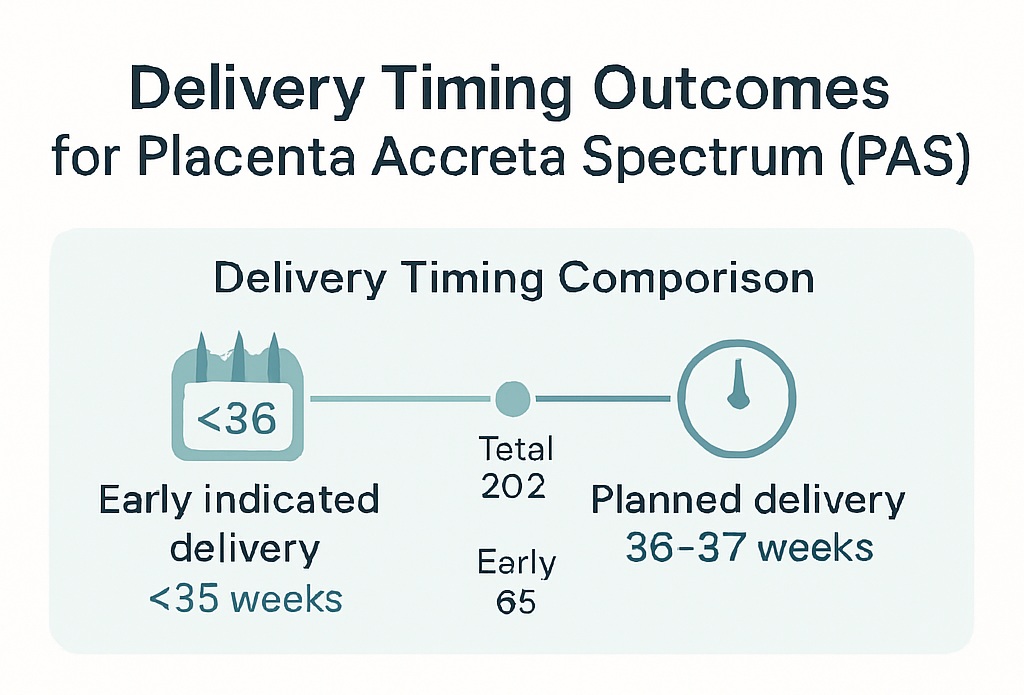
The article investigates the optimal timing for delivery in pregnancies complicated by prenatally suspected placenta accreta spectrum (PAS). At a large tertiary care center, the study finds that, in the absence of urgent indications such as bleeding or labor, planned delivery at 36–37 weeks is feasible and safe. Later delivery does not increase maternal morbidity but significantly improves neonatal outcomes due to reduced prematurity-related complications. The study recommends shared decision-making between providers and patients, emphasizing the importance of hospital proximity and specialized multidisciplinary care for PAS management

Balancing Technology and Real Life
  • Study Design: Retrospective cohort of 202 patients with suspected PAS compared outcomes by delivery timing (before vs. after 36 weeks).

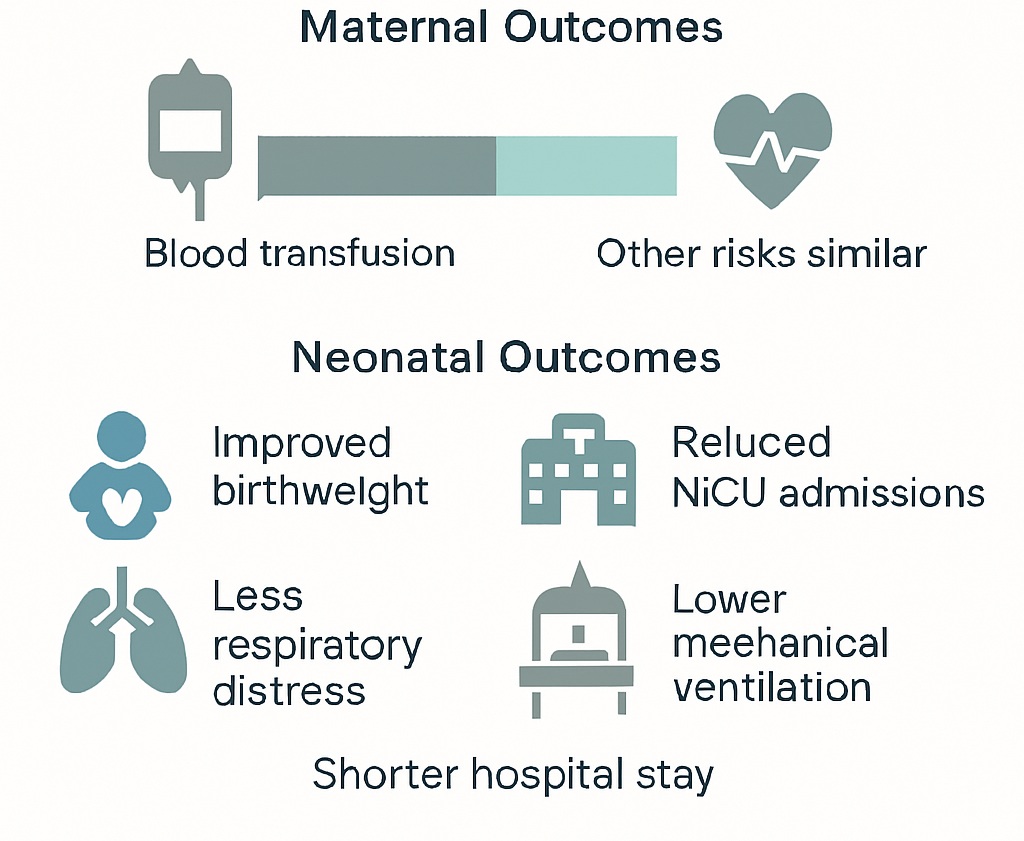
  • Findings: Later delivery (36–37 weeks) does not worsen maternal outcomes but improves neonatal birthweight and reduces NICU admissions, mechanical ventilation, respiratory distress syndrome, and overall hospital stay.

  • Urgent Indications: Early delivery is still required in cases with antepartum complications (bleeding, labor, rupture of membranes, etc.), but unplanned deliveries did not show increased maternal complications in this specialized center.

  • Clinical Implication: Delaying planned delivery to 36–37 weeks is safe for uncomplicated PAS cases at tertiary centers, supporting a patient-centered, individualized approach.

  • Research Recommendations: Need for further multicenter studies; findings may not generalize to hospitals without PAS teams or those not in close proximity to patients.

The conclusion of the study on delivery timing for placenta accreta spectrum (PAS) is that patients with suspected PAS who do not have other indications for early delivery, such as bleeding, labor, rupture of membranes, or preeclampsia, can safely have planned delivery in the late preterm or early term period (36 to 37 weeks gestation) at specialized centers geographically close to the patient. Delayed delivery does not negatively affect maternal outcomes but significantly improves neonatal outcomes, reducing complications related to prematurity such as low birthweight, NICU admission, respiratory distress syndrome, need for mechanical ventilation, and length of hospital stay. The study supports individualized, shared decision-making regarding delivery timing in PAS pregnancies managed at tertiary care centers with a multidisciplinary approach.

This finding provides important evidence that later delivery (beyond current recommendations of 34 to 35 6/7 weeks) is feasible and beneficial in uncomplicated PAS cases, emphasizing the significance of care center capabilities and patient proximity for optimal outcomes.

Patients with prenatally suspected placenta accreta spectrum whose antenatal course does not require urgent delivery can be considered for planned delivery at 36 to 37 weeks of gestation.
5 5 0 1

Managing placenta accreta : delivery timing insights

Study finds that delaying planned delivery to 36–37 weeks in uncomplicated placenta accreta spectrum pregnancies at specialized tertiary care centers safely improves neonatal outcomes without increasing maternal risks; highlights need for individualized, multidisciplinary care.

    5.0 / 5

    • delaying planned delivery
        5/5 Amazing

        Study finds that delaying planned delivery to 36–37 weeks in uncomplicated placenta accreta spectrum pregnancies at specialized tertiary care centers safely improves neonatal outcomes without increasing maternal risks; highlights need for individualized, multidisciplinary care.

      Pros
      Cons
      Show Comments (0) Hide Comments (0)
      0 0 votes
      Article Rating
      Subscribe
      Notify of
      guest
      0 Comments
      Oldest
      Newest Most Voted
      Inline Feedbacks
      View all comments
      0
      Would love your thoughts, please comment.x
      ()
      x