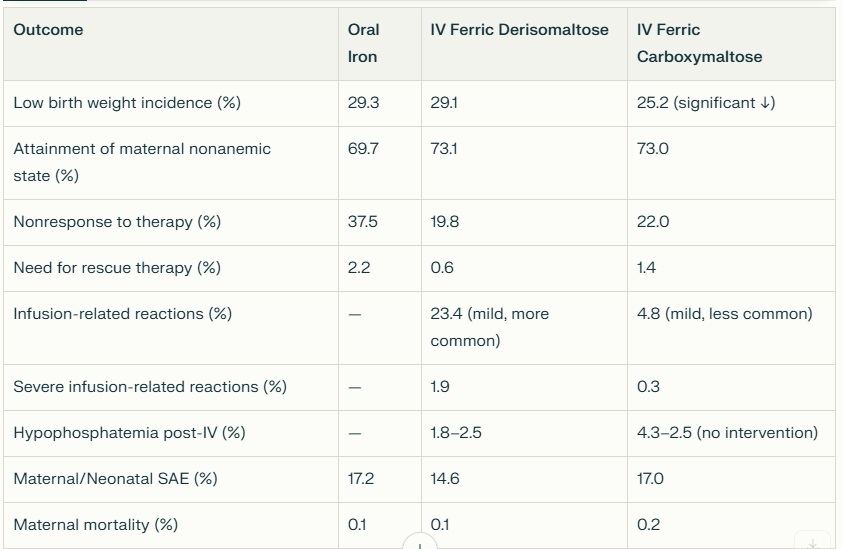
Summary of the article “Single-dose intravenous iron vs oral iron for treatment of maternal iron deficiency anemia: a randomized clinical trial.” published in American Journal of Obstetrics and Gynecology Volume 233, Issue 2, August 2025 presents a large, multicenter, randomized controlled trial comparing single-dose intravenous (IV) iron (ferric carboxymaltose or ferric derisomaltose) with standard oral iron for moderate iron deficiency anemia in pregnancy. The study, conducted in India, examined maternal hematologic outcomes and neonatal health, especially low birth weight (LBW).
LBW incidence: Reduced with IV ferric carboxymaltose (25.2%) vs oral (29.3%); no significant reduction with ferric derisomaltose.
Nonanemic state (Hb ≥11 g/dL): Similar across groups, but sensitivity analysis showed higher rates with both IV arms compared to oral.
Rescue therapy/transfusion: Less frequent in IV groups.
Safety: Mild infusion reactions; hypophosphatemia noted with ferric carboxymaltose but clinically manageable.
Low Birth Weight: Intravenous ferric carboxymaltose significantly reduced the incidence of low birth weight infants compared to oral iron. Intravenous ferric derisomaltose did not show a similar effect.
Maternal Anemia: Neither IV iron formulation was superior to oral iron in achieving a non-anemic state at delivery. However, a sensitivity analysis showed that both IV iron groups had a significantly higher rate of achieving a non-anemic state without requiring additional iron or blood transfusion.
Single-dose IV iron, particularly ferric carboxymaltose, is superior to oral iron in reducing LBW and achieving non-anemic status in pregnant women with moderate IDA. Clinical guidelines should consider IV iron as a primary treatment option.